Geothermal Well Drilling in Upstate SC: What Homeowners Need to Know in 2026
Geothermal Well Drilling in Upstate SC: What Homeowners Need to Know in 2026
Every October, heating bills start creeping back into conversations around the Upstate. And every year, more homeowners ask the same question: is there a smarter way to heat and cool this house?
For a growing number of rural and semi-rural families in Greenville, Spartanburg, and Anderson counties, the answer is geothermal — a ground-source heat pump system that uses the earth's own steady temperature to heat your home in winter and cool it in summer. The technology isn't new, but questions about it definitely are. Here's a plain-spoken breakdown of how it works, what the drilling involves, and what's changed in 2026 that every homeowner should know before making a decision.
How a Geothermal System Actually Works
A geothermal heat pump doesn't create heat the way a furnace does. It moves heat — from the ground into your house in winter, and from your house back into the ground in summer. The reason this works is simple: a few feet below the surface, ground temperature stays stable year-round, typically somewhere around 55–60°F. It doesn't matter if it's July in Simpsonville or January in Greer. The ground stays the same.
A geothermal system takes advantage of that stability through a ground loop — a network of buried pipes that circulates a water-and-antifreeze mixture between the earth and your indoor heat pump. The heat pump concentrates that energy and distributes it through your existing ductwork, just like a conventional system. The difference is efficiency: ground-source systems can deliver three to four units of heating or cooling for every single unit of electricity consumed.
That's a meaningful difference compared to electric resistance heat — and a significant operating cost advantage over propane or oil, especially as fuel prices remain unpredictable.
Vertical vs. Horizontal Loop Fields: What Applies in Upstate SC
There are two main ways to install a geothermal loop field: horizontal trenches or vertical boreholes. In the Upstate, vertical drilling is almost always the right choice — and here's why.
Horizontal Loops
Horizontal loops are trenched 4–6 feet underground and require a large amount of open land — roughly 500–750 feet of trench per ton of system capacity. If you're on 10 acres of cleared farmland, this might work. For most residential properties in Fountain Inn, Fork Shoals, Travelers Rest, or Greer, you simply don't have the usable yard space, or the trenching would tear up too much of your property.
Vertical Boreholes (The Upstate Standard)
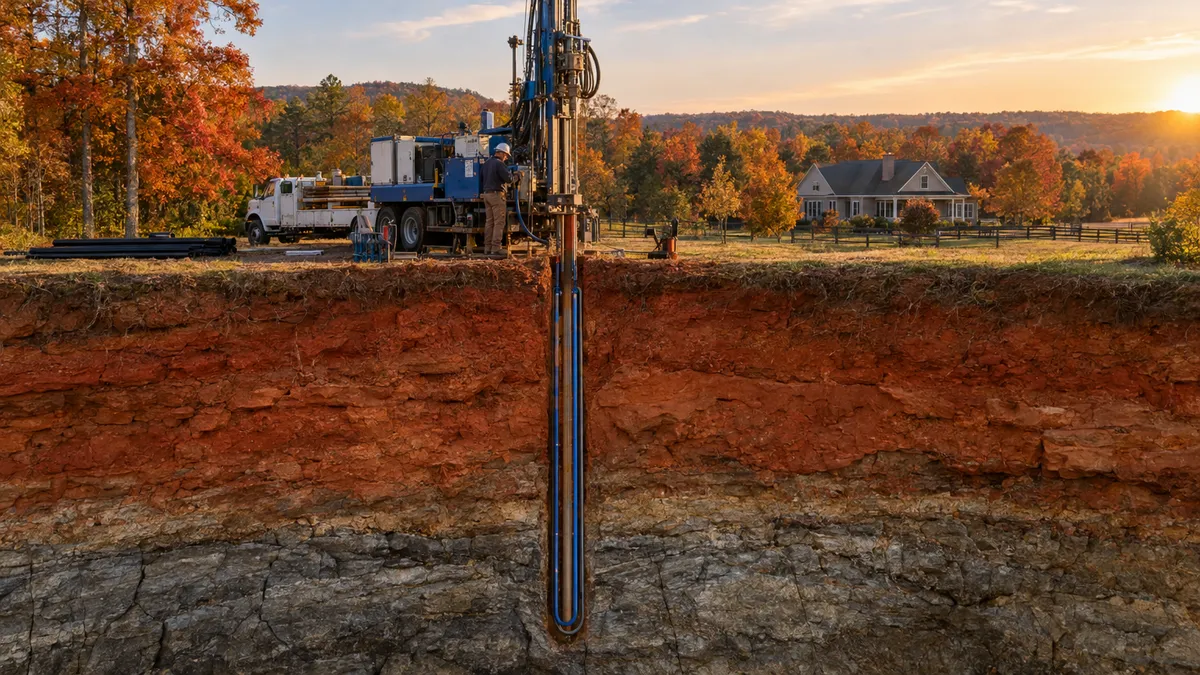
Vertical loops require drilling straight down — typically anywhere from 150 to 500 feet per borehole, depending on how much heat-exchange capacity the system needs. Each borehole only uses a few square feet of surface area, so your yard stays largely intact. A certified well driller sets up the rig, drills the borehole through the soil and into bedrock, installs high-density polyethylene (HDPE) loop pipes, and groutes the hole to protect groundwater and improve thermal performance.
In Upstate South Carolina, wells typically pass through red clay, weathered rock (what drillers call saprolite), and then into solid bedrock — the same geological profile Kellett's has been drilling through since 1963. The familiarity with local soil and bedrock conditions isn't a small thing. It affects how the borehole is cased, how deep you have to go to reach consistent thermal conductivity, and how the grouting is done to protect your water quality and the environment.
What Changes at the Property Line: Water Well vs. Geothermal Well
Many homeowners who already have a water well wonder whether the same hole can do double duty. The short answer: sometimes, but usually not directly. Here's how to think about it:
- Closed-loop geothermal — the most common residential setup — uses a completely sealed pipe system. The heat-transfer fluid never contacts your groundwater. Separate boreholes are drilled specifically for the loop field.
- Open-loop systems — draw groundwater directly through the heat pump and return it to the aquifer. This requires good water quality and adequate well flow, and may need regulatory approval depending on the application.
- Standing column wells — a single well that provides both domestic water and geothermal function simultaneously. This is a specialized design that's less common but worth asking about if you're drilling a new well from scratch on a new build.
At Kellett's, we drill the vertical boreholes for the geothermal loop field. The heat pump itself — the indoor unit that moves the heat around your house — is installed by your HVAC contractor. We work alongside them so the whole system comes together the right way.
The 2026 Incentive Landscape: Honest Talk
If you've been researching geothermal for a few years, you may have seen references to a 30% federal tax credit. That credit ended after December 31, 2025. The One Big Beautiful Bill Act, signed in July 2025, terminated the §25D Residential Clean Energy Credit for new installs. If your system was placed in service in 2025, you can still claim it — but any 2026 installation is ineligible for that federal benefit.
That's a real change, and it increases the payback period for most homeowners. That said, geothermal still makes strong financial sense in the right situations:
- You're replacing expensive fuel — propane, oil, or electric resistance heat.
- You plan to stay in the home long-term. The loop field lasts 50+ years.
- You want stable, predictable heating and cooling costs regardless of what fuel prices do.
- State or utility rebates in South Carolina may partially offset costs — always worth checking current availability with your utility provider and a tax advisor.
The upfront investment is real. So is the long-term payoff. The math works best for homeowners who are thinking in decades, not just next winter's bill.
How the Drilling Process Works, Step by Step
For most homeowners, the drilling process is unfamiliar territory. Here's what to expect when you work with a licensed well driller for a geothermal project in South Carolina:
- Site assessment — We look at the property, discuss the system size your HVAC contractor recommends, and determine how many boreholes are needed and where they'll be located (setback rules from the house, septic, and property lines apply).
- Permitting — New boreholes in South Carolina require permits. Your driller handles this as part of the project scope.
- Drilling — The rig goes to work. In Upstate geology, we drill through clay and saprolite into bedrock. Depth and number of boreholes depend on the heat load your HVAC contractor has calculated.
- Loop installation and grouting — HDPE loop pipes are inserted into the boreholes and grouted in place. Grouting improves thermal conductivity and — critically — creates a seal that protects groundwater quality.
- Pressure testing and connection — The loop system is pressure-tested before being connected to your HVAC contractor's heat pump equipment inside the home.
Drilling a typical residential geothermal loop field usually takes several days to a couple of weeks, depending on the number of boreholes and site conditions. Your HVAC contractor's timeline for the indoor equipment installation runs in parallel.
Why Local Drilling Experience Matters
Geothermal drilling isn't just about going deep. It's about going deep correctly through the specific geology under your property. Upstate South Carolina has its own profile — the clay-to-saprolite-to-bedrock layering affects how fast you reach the stable thermal mass you need, how the borehole is cased, and how grouting is done to protect the surrounding water table.
That's not something you learn from a manual. It's something you learn from decades of drilling in Greenville, Spartanburg, Anderson, Pickens, and Laurens counties. Kellett's has been doing exactly that since the 1960s — family-owned, locally based, and familiar with the ground under this part of South Carolina in a way that a regional or national contractor simply isn't.
When you're making a long-term investment like geothermal, who drills the hole matters as much as the heat pump inside your house.
Frequently Asked Questions
Can I use my existing water well for a geothermal system?
Sometimes. Open-loop systems use groundwater directly, which requires adequate flow and good water quality. Closed-loop systems — more common and more protective of your water supply — use separate boreholes with sealed pipes. We'll help you figure out what makes sense for your property.
How deep will the geothermal boreholes be?
It depends on the size of the system your HVAC contractor specifies and the thermal conductivity of the ground. In Upstate SC, residential vertical boreholes typically range from 150 to 400+ feet. The exact depth isn't known until site assessment and system design are complete.
Do geothermal wells in SC need a permit?
Yes. New boreholes in South Carolina require permits, and there are setback rules from property lines, structures, septic systems, and water sources. A licensed driller handles the permitting process as part of the project.
Does geothermal work in Upstate SC's climate?
Very well. Geothermal systems perform consistently because they rely on ground temperature, not air temperature. The Upstate's hot summers and occasionally cold winters are exactly the kind of climate where you notice the efficiency advantage most.
How long does the loop field last?
The buried HDPE loop pipes are generally designed to last 50 years or more with proper installation and grouting. The heat pump indoor unit has a shorter service life, similar to conventional HVAC equipment, but the loop field is a long-term asset.
Do I need to find my own HVAC contractor?
Kellett's drills the wells and installs the loop field. The heat pump indoor unit is installed by an HVAC contractor. We're happy to work alongside your HVAC professional to make sure the system comes together correctly.
Ready to Talk Geothermal?
If you're thinking about a geothermal system for your Upstate SC home or business — whether it's a new construction project, a land build, or a replacement for an aging heating and cooling system — start with the well drilling conversation.
Kellett's Well Boring Inc. has been drilling the Upstate since the 1960s. We know the soil, we know the bedrock, and we know how to drill a geothermal borehole the right way — safely, in compliance with South Carolina requirements, and with the groundwater protection that keeps your property and your neighbors' property clean for years to come.
Contact Kellett's Well Boring today to schedule a site visit and get a quote for your geothermal loop field project. Visit us at kellettswellboring.com or stop by 3447 Fork Shoals Rd, Simpsonville, SC 29680.
